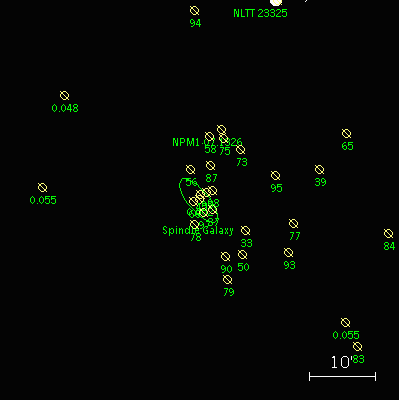
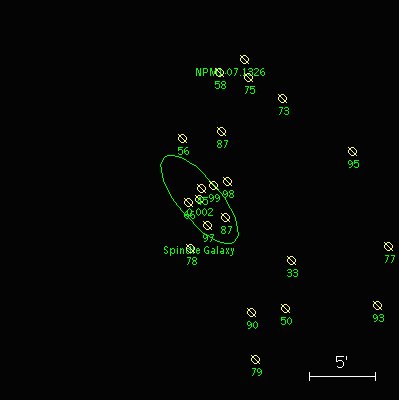
NGC 3115 -- E-S0 galaxy, sky charts (1 degree & 30 arcmin sides) with list of objects below, in order of distance from galaxy at center.

comment on field displayed below: Objects bunched close in to galaxy. Closest objects would usually be thought of as ULXs (within the galaxy), but spectroscopy often reveals such "ULX"s to be QSOs.
   
label coordinates (J2000) dist asec angle E-N type R mag B mag com R psf B psf Name conf assoc QSO pct z flux
0.002 100513.8-074303 0 GX 9.6 11.7 pvm 1 n NGC 3115 91 0 0.002 21
45 100513.2-074217 47 349 X 19.6 20.3 * 2 CXOMPJ100513.1-074217 93 45 7
66 100517.2-074319 52 108 X 20.0 21.6 * * CXOMPJ100517.1-074319 86 66 13
99 100509.6-074201 89 314 X 19.5 20.7 * * CXOMPJ100509.6-074200 99 99 25
97 100511.4-074500 122 197 X 20.2 20.7 v * * CXOMPJ100511.4-074459 97 97 3
87 100506.1-074428 143 234 X 20.1 21.1 * * CXOMPJ100506.0-074428 91 87 65
98 100505.6-074142 146 304 X 20.5 21.6 * * CXOMPJ100505.6-074141 98 98 5
78 100516.8-074647 228 169 X 19.8 20.9 * * CXOMPJ100516.7-074647 91 78 5
56 100519.1-073828 286 16 X 21.1 21.8 * 1 CXOMPJ100519.1-073829 96 56 7
87 100507.2-073758 321 342 X 20.7 21.8 * * CXOMPJ100507.2-073757 91 87 9
33 100446.2-074739 495 236 X 19.7 21.3 * * CXOMPJ100446.3-074738 68 33 3
90 100458.2-075133 560 204 X 21.0 21.5 * * CXOMPJ100458.3-075133 92 90 13
58 100507.8-073332 578 351 X 18.2 18.9 p * * 2RXP J100507.7-073341 72 58 6
73 100448.9-073529 586 321 X 20.5 21.4 * * CXOMPJ100448.9-073530 77 73 23
75 100459.2-073355 590 338 X 20.0 20.5 1 * 2RXP J100459.0-073357 92 75 6
50 100448.0-075117 625 218 X 20.4 21.7 1 * CXOMPJ100448.0-075117 95 50 17
NPM1- 100500.2-073233 662 342 SX 12.6 14.2 p 2 1 NPM1-07.1326 79 0 17
95 100427.7-073929 718 287 X 20.8 20.7 * * CXOMPJ100427.6-073929 99 95 13
79 100456.9-075506 766 199 X 19.1 18.7 p * * CXOMPJ100457.1-075504 94 79 18
77 100416.6-074635 877 256 RX 17.6 20.0 p * * FIRSTJ100416.5-074634 100 77 108
93 100420.0-075103 933 239 X 19.9 20.1 * * 2RXP J100419.9-075105 95 93 13
39 100400.9-073833 1117 284 X 21.0 21.0 * * 2RXP J100401.1-073821 42 39 16
0.055 100648.6-074113 1413 86 GR 13.1 14.6 pv 1 1 6dF J100648.6-074112 98 0 0.055 1
65 100345.0-073310 1447 294 R 14.6 15.7 p * * FIRSTJ100345.0-073308 89 65 24
0.048 100635.4-072725 1533 52 GR 12.8 14.1 pv 1 1 MK 1245 100 0 0.048 1
94 100516.6-071445 1699 1 R 20.5 21.1 * * FIRSTJ100516.6-071444 98 94 3
0.055 100345.2-080125 1718 230 GR 15.1 17.4 p 2 1 6dF J100345.1-080125 93 0 0.055 3
84 100319.4-074807 1728 260 X 17.4 18.1 p * * 2RXP J100319.8-074810 88 84 126


Columns of table:

  1. label -- identifier for each optical object displayed on the chart(s) above.
  2. coordinates J2000 -- position on the sky of this optical object, pattern is hhmmss.s±ddmmss, which gives 1 arcsecond precision.
  3. dist asec -- distance (offset in arcseconds) of this object from the central galaxy, i.e. the center of the chart.
  4. angle E-N -- direction from the central galaxy to this object, N thru E, ie. 0 is up, 90 is left, 180 is down, 270 is rightwards.
  5. type -- short description of this object: Q=quasar, B=Bl lac, A=AGN, G=galaxy, S=star, X=X-ray source, R=radio source, 2=double radio lobes.
  6. R mag, B mag -- brightness of this object in red and blue colors respectively, 0=not seen in this color
  7. com -- comment on object: p=blue is POSSI-O violet, (no p)=blue is Bj green or similar, i=red is i, u=blue is u, v=variablility nominally detected, m=proper motion nominally detected, ?=inferred object, calculated from combining APM and USNO-A optical catalogs.
  8. R psf, B psf -- appearance of object in red and blue colors respectively, *=stellar, 1=fuzzy, 2=extended, n=no psf, x=not seen in this color.
  9. Name -- name of this object from the literature, or IAU name from X-ray/radio catalog.
  10. conf assoc -- confidence that this optical object is the true source of the X-ray or radio detection that we list with it. This is the published figure from the QORG catalog, except for XMM or CXOMP X-ray objects which are calculated using the identical technique as used in QORG.
  11. QSO pct -- confidence that this optical object is a QSO specifically, calculated as in (10) above.
  12. z -- the redshift of this object, from the literature. NBCKDE redshifts are photometric only, and rounded to tenths, e.g. 1.700.
  13. flux -- if a radio source, in mJy; if an X-ray source, in counts per hour as listed in ROSAT/CXOMP, XMM normalised to ROSAT (div by 3.5).


Return to Galaxies menu